Interview
'The cultural activists of 1971 are not recognised properly' --Rathindra Nath Roy
Novera Deepita
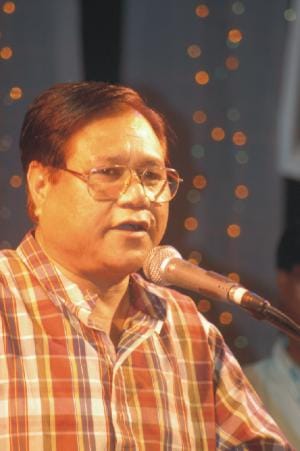
Rathindra Nath Roy was one of most prominent performers of the Swadhin Bangla Betar Kendra (Radio Centre of Independent Bangla). Recalling his early singing career, he mentions patriotic songs such as Purba digante shurjo uthechhe and Nongor tolo tolo(the music director was Samar Das), Rokto die nam likhechhi (Shujeo Sham) and songs like Bicharpoti tomar bichar (Ajit Roy). He also sang some Tagore songs such as O amar desher mati which earned popularity among the Bangalis during the Liberation War. In Roy's view there are few parallels to these patriotic songs. In his words, 'The spirit, the environment and the passion cannot be seen nowadays. Think about those songs during the Liberation War. Is there any contemporary song that can appeal to the people like those golden ones?' Roy has also done his bit to promote folk songs, especially Bhaoaiya songs that are popular in the Rangpur area. In 2002 he established the Bhaoaiya Academy in Rangpur and branches in all the zillas of Rangpur like Gaibandha, Kurigram and Nilmonirhat. The objective of this academy is to promote folk songs through teaching students and youngsters and organising cultural programmes. Roy also has plans to launch a research -oriented publication and a quarterly on Bhaoaiya music. According to Roy, folk music is deeply embedded in Bangladeshi culture. To quote him, 'Folk music is the music of soil, mother and soul. It is like a relationship between mother and child, which can never be torn. As long as this land exists, there will be folk music. Rock, pop or any other modern music can never take away the appeal of folk music because it has a strong base.' Roy also performs songs such as Bhajan, Kirtan, Shyama Sangeet, Murshidi and Marphati songs in the Ramkrishna Mission for a long time because he took interest in the sadhus. He says, 'These sadhus are not only devoted to the religion but also very literate and inclined towards social work.' He adds,' These monks devote themselves to the service of the common people who are affected by natural calamities. This is why I have an attraction for these monks and perform for them.' He has written and put to tune some of these spiritual songs such as biswa bibek jagate dhoray ele bibekananda and Sri sri ma tumi je amar. Roy joined the Swadhin Bangla Betar Kendra in May during the Liberation War. Reminiscing on those days, he says, 'There were very few facilities in the radio station which was housed in a simple residence. It was quite difficult for the personnel to carry out their work. We had our dining hall downstairs and the studio was not even sound proof. It was a one-channel machine with which we used to do all the recordings. There was no place for commercialism, since the performers, instrumentalists and engineers were dedicated to their medium.' Roy, a devoted folk singer, especially the Bhaoayia genre, began to perform in 1960. At that time he was the youngest member of the Bhaoayia Song Group from Rangpur in the folk music festival of the then Radio Pakistan Dhaka. His singing career soared after that event. He became a regular singer of the radio and television. Initially his guru was his father Harolal Roy and later Ustad PC Gomez. He performed in a good number of programmes when he was a student of Dhaka University. Roy feels that the new television channels are not promoting folk songs adequately. As he says, 'None of the TV channels have their own professional studio, which is a must for a television channel. If they want to produce special programmes on folk music, they need more facilities.' His major grouse against BTV is that this channel, unlike the radio medium, does not telecast folk music at prime time. Roy has a few reservations about stage shows as well. As he says, 'There are a very few solo and group folksong programmes on stage nowadays. This is because the modern music, commonly known as band music, is given preference over folk music.' In his view, folk songs programmes appeal more to the elderly people. Roy is not reluctant to give credit to those who popularised the folk songs by remixing them. But he does not consider those pieces as folk music because if there is no flute, Dotara or Ektara it will not be folk music. And he is unwilling to perform folk music with modern instruments. Roy is also a playback singer and has won many awards like BACHSHASH (Bangladesh Cine Journalists Society) Award in 1979 and 1981, The Ekushey Padak in 1994 and the Popular Folk Song Award in the World Youth Festival in East Germany in 1973. Though he is a big name in folk music, he has some regrets and he really works hard to promote folk song in the country. But he still regrets that the cultural activists at the time of the Liberation War have not been given their due. As he says pointedly, 'There are many awards for the frontline fighters but none for the cultural activists at that time.'
|