Exhibition
Content with nature
Md. Shamsul Alam Azad's solo at Chitrak
Fayza Haq
One saw Shamsul Alam Azad's inherent love for nature in all his paintings recently exhibited at Chitrak. He says that he does not base his works on the forms found in nature. "I feel that there are limitations in forms," Azad says. "Everyone sees grass, leaves, trees, sky and the earth. To depict them as they are in a photographic way would be outdated. I try to find new feelings in nature: the feelings that nature around stirs up in me." Consequently, without doing any basic drawings, he scatters colours on his paper. These include green, yellow, brown, gray and black. But the blue is not necessarily the sky or green the leaves. He wants to establish something new in his fresh vision of nature. The brush is not used to paint leaves or stems or flowers: it has been used to create atmosphere and feelings.Water colour, acrylic and oil have been used to give the impressions. Asked why he liked water colour, Azad says that most artists begin with water colour and that it is a medium that can be easily handled. He has tried to capture the play of light and shade in the depths of the forests. He does not use any photographic images or memories but plays with the colours until they satisfy him. Azad was born and brought up in Barisal, where he had the experience of being surrounded with masses of green, as he roamed around as a child in fields and forests, coming across lakes and groves. As a student too, in the Institute of Fine Arts, he found the pleasant Ramna Park nearby, the greenery in the institute itself, and was specially intrigued by a green pond. As he sees the city growing around him, nature is being destroyed. He says he cannot plant or grow trees to replace the ones that are being removed in the name of progress, but he can create the ambiance of peace and harmony that nature creates in his green, blue and yellow strokes of his paintings. Talking about the influences on him Azad says that he likes the artists who deal with nature, such as Mohammed Kibria, Rafiqun Nabi, Mahmudul Haque, and Kazi Ghiyas. Azad says, "When Mohammed Kibria paints, everything is taken from life around him; Rafiqun Nabi paints beautiful landscapes even today. Mahmudul Haque's works too were once very closely related to nature. Recently there was an exhibition of Mokhlesur Rahman's prints where sand banks, river waves and ripe paddy fields dominated the woodcuts. " Azad has no fixed time for working; it rather depends upon his mood. Sometimes, he says, he has spent hours in his studio accomplishing nothing, while there have been times when he has worked ceaselessly into the night. Asked whether or not he felt a sense of boredom in dealing with the same subject of nature, Azad says, "When all my 45 paintings had been hung, I still felt that I have a lot to achieve, keeping to the same theme. I feel a painter should deal with the subject that he knows best. He should not try to bring in subjects that does not attract him just to bring in variation." In Mind of Nature-2 we find a splash of green that is merged with a darker shades of green and black and touched with brown, mauve and orange. At the back are shades of gray with texture work. Mind of Nature-1 brings in the image of the round pond in the Institute quite unconsciously Azad has taken part in over 15 joint exhibitions, including the 8th, 9th and 11th Asian Art Biennale, and has participated in four workshops.
|
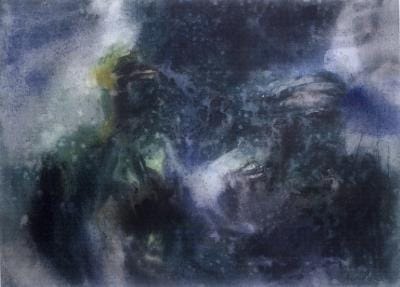
Mind of Nature-3, water colour |

