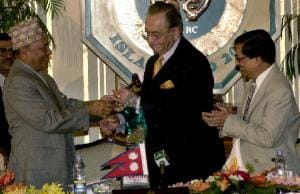
Current peace move is my last attempt: Vajpayee
Kashmir issues won't be ignored
PTI, AFP, Islamabad
Asserting that the current peace initiative with Pakistan was his "last attempt", Prime Minister Atal Bihari Vajpayee has said terrorism was the biggest obstacle in the way of solving Kashmir and other issues between India and Pakistan."This is my last attempt", Vajpayee, who will arrive in Islamabad today to participate in the Saarc summit told Pakistan daily 'Dawn' in an wide ranging interview, indicating that age was not in his side to continue with such efforts in future. Sounding conciliatory with hints to make some important confidence building measures to supplement the ones made by the two countries in the past few months, Vajpayee sounded categorical in asserting that only terrorism remained a hurdle for resolving the vexed issues between the two countries. Stating that there was vast consensus in India for peace initiatives with Pakistan, Vajpayee said the widespread impression in India was to see whether the Indian peace initiatives were getting matching response from Pakistan. AFP adds: India is open to discussing the decades-old territorial dispute over Kashmir with Pakistan, Prime Minister Atal Behari Vajpayee said in an interview published yesterday on the eve of a regional summit. But its concerns at "terrorism" in the Himalayan state, where anti-India militants have been waging a bloody insurgency against Indian rule since 1989, must be addressed first, he told Pakistan's Dawn newspaper. "I can see no obstacle to establishment of a climate of friendship and cordiality in which we can discuss and resolve all our outstanding bilateral issues including Jammu and Kashmir," Vajpayee was quoted as saying. Issues concerning Kashmir, claimed by both India and Pakistan but divided between them since 1948, will not be ignored, he said. "They will remain on the agenda. If we can discuss them with friendship and understanding -- rather than suspicion and hostility -- we are likely to find acceptable solutions much earlier," he told the English-language daily. The Indian leader's comments were published a day ahead of his arrival in Islamabad -- on his first visit to neighbouring Pakistan since 1999 -- for a regional South Asia summit. Hopes are high that both sides will use the summit for their first meeting, albeit informal, since coming close to war for most of 2002 following an attack on India's parliament. New Delhi blamed Pakistan-backed militants for the December 2001 attack, in which 14 people including the five gunmen were killed. Pakistan denied any link but India deployed massive troop numbers to their common border and Pakistan followed suit, pitching the region on the brink of a feared nuclear conflict. Since Vajpayee's "hand of friendship" offer in April 2003 both sides have moved to mend ties, reviving diplomatic and transport links severed since 2002, and initiating an unprecedented ceasefire along boundaries in Kashmir. Vajpayee, 79, acknowledged however that "both countries have taken several positive steps since then" and said the ceasefire meant cross-border infiltration by militants into Indian-held Kashmir could no longer take place. However he repeated that this was his final bid for peace with Pakistan. "This is my last attempt," he said. The reason bilateral talks had still not taken place, despite eight months passing since his peace offer, was ongoing concerns in New Delhi at "terrorism" in Indian-held Kashmir, Vajpayee said. He was optimistic however at the new momentum for peace and urged both sides take advantage of it. "These eight months have witnessed the groundswell of popular enthusiasm in the people of both our countries, parliamentarians and political workers, businessmen and professionals, artists and social activists -- for a normal, peaceful and cooperative bilateral relationship," Vajpayee said. "We should build on the momentum and on the recent positive developments in a constructive manner." Asked what factors were forcing the nuclear neighbours to mend ties, he named popular demand and globalisation pressures for "faster economic development." "In the post-Cold War world, it is in our national interest to join hands in tackling the many common problems we face in our countries and with the outside world," he added.
|