Accord on three pacts before Saarc summit
Reuters, AFP, Islamabad
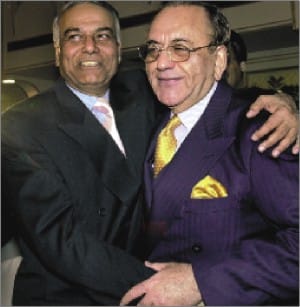
South Asia's foreign ministers have agreed on three key pacts to be signed at a landmark regional summit opening in Islamabad this weekend, India's Foreign Secretary Shashank said yesterday. "This development (agreement on three documents) would contribute in achieving even bilateral progress," Shashank told a briefing in the capital, striking a positive note on the eve of the seven-nation summit. The accords were reached during meetings that began on a high note when Indian and Pakistani foreign ministers Yashwant Sinha and Khurshid Mahmud Kasuri publicly embraced, raising hopes for cordiality between the rival states' leaders at their first encounter since near-war in 2002. Agreements on free trade, terrorism and a social charter top the agenda of the 12th summit of the South Asian Association for Regional Cooperation (Saarc), which groups Bangladesh, Bhutan, India, the Maldives, Nepal, Pakistan and Sri Lanka. "Three documents have been agreed," Shashank told a briefing after the foreign ministers' meeting, referred to as the Council of Ministers. They include an expanded regional terrorism agreement, the South Asia Free Trade Agreement (Safta), and a social charter, he said. "Contrary to the earlier feeling that there might be some delays, somehow considerable progress has been made during consultations of the Council of Ministers." Shashank said an agreement was reached on an "additional protocol" to an existing anti-terrorism agreement, referring to an extra clause on choking terrorist funding. "Differences had come because of its definition and scope and the debates in the UN, OIC and other fora. It was possible to bring the focus on the main issue." Safta had also met problems in earlier negotiations, mainly over smaller countries' anxieties that they would need extra concessions to create a level playing field with India and Pakistan. "However ... it was possible to get over most of the differences and an agreement has been reached even on Safta. The text of the document may have just been cleaned up," Shashank said. Kasuri was buoyant on prospects for the signing of Safta, which business leaders hope will transform the home to half the world's poor into a powerful trade bloc. "I have just come back from the meeting where there was a great degree of warmth and candour and friendship," Kasuri said of the foreign ministers' meeting. "If we proceed in the same manner in the second session (Saturday), maybe our heads will be, or the summit will be, ready to sign the Safta agreement." A Pakistani official involved in the negotiations on the amended terrorism pact said it was directed at international terrorism, insisting it did not relate to the insurgency in disputed Kashmir, which Pakistan considers a struggle for self-determination and India considers terrorism. "The drafting and approval of the anti-terrorism protocol at the delegate level marks a step towards developing a coherent regional response for dealing with the threat of transnational terrorism," the official said. A report on poverty alleviation was also approved, as was the establishment of a regional development bank, Shashank said. It was also decided that India would prepare a report on a freedom-from-hunger project within the next three months. Saarc heads of government will open the three-day summit, the forum's first in two years, on Sunday. Observers are hoping the nuclear neighbours' leaders will meet for the first time since the tensions on the summit's sidelines. India's Sinha and Pakistan's Kasuri posed for the cameras smiling and with an arm around each other's backs. Speaking to reporters with Kasuri at his shoulder, Sinha did not rule out ice-breaking, one-on-one talks between Indian Prime Minister Atal Behari Vajpayee and his Pakistani counterpart Zafarullah Khan Jamali or President Pervez Musharraf on the summit sidelines. "We have said that it has not been decided yet," he said before the meeting. "Let the prime minister come tomorrow." Sinha said the leaders would in any case be meeting at the summit. "They will be meeting socially," he said. Discussion of bilateral issues at the Saarc summit is forbidden by its charter, but Musharraf and Vajpayee may use the occasion to advance the shaky reconciliation process. A breakthrough in their dispute over the Himalayan region of Kashmir is seen as unlikely, but the very fact Vajpayee is visiting Pakistan is seen as a sign of progress. At best, diplomats say, there is a chance the two sides might quietly agree to open lower-level dialogue between foreign ministry bureaucrats. In an interview published yesterday, Vajpayee said he was optimistic the dispute could be solved in his lifetime, but only if Islamabad gave up its insistence that Kashmir belonged to Pakistan because of its Muslim majority. "I remain optimistic about it. But there has to be a fundamental change in Pakistan's perspectives," he said. "Until it changes its perception about Jammu and Kashmir -- that because it is a Muslim-majority state, it should be a part of Pakistan -- no meaningful discussion can take place on this matter." HUGE SYMBOLISM Earlier, business leaders said Pakistan and India's $1.5 billion trade through unofficial channels and third countries could double with a trade deal and better relations. But there are concerns around the region about dismantling trade barriers that would allow cheap Indian goods to flood markets. Even after a trade deal is signed it is far from clear it will be implemented, analysts say. One western diplomat said the immediate economic benefits of a free trade agreement might be limited. "But in terms of symbolism and politics it's huge," he told Reuters.
|